The same day The New York Times published its investigation of labor rights leader César Chávez’s alleged actions of sexual abuse, Bakersfield College professor Oliver Rosales was scheduled to teach his class, History of Chicanos in the Southwest. His planned lecture happened to be on the farmworker movement.
Read more ‘Pretty sure he’s wet:’ Immigration agents used racial slurs during LA sweeps, court records show
But on that day in March, he swapped out a reading on the Delano Grape Strike for The Times investigation, including a testimony by Dolores Huerta, co-founder of the United Farm Workers, who revealed that Chávez raped her on two seperate occasions. The Times investigation also revealed a pattern of Chávez sexually abusing women and girls who were a part of the UFW.
“Some students used words like ‘shock,’ ‘devastating,’ ‘gut wrenching,’ ‘soul shaking,’” Rosales said. “I was glad that it’d be in that moment with students at that time. I wouldn’t want to be anywhere else in the world, if you will, when that story broke.”
As a historian who has studied and taught about the farmworker movement for years, Rosales, along with many other scholars, was just as shocked. Now, college faculty across California are evaluating the research and teaching approaches they will take when it comes to California’s farmworker movements.
“I was in a text chain with different professors from across the country, and we were just in shock, because no historian knew about this,” Rosales said. “This definitely feels like a second, social death.”
Chávez died at the age of 66 in 1993, leaving a legacy that has grown in California history. Over 130 public spaces and monuments have been named after Chávez nationally. In California, over 65 streets, schools and parks carried his name. Since 2000, the state recognized his birthday as a state holiday.
Higher education institutions immediately responded to the allegations against Chávez by renaming and removing public markers. Now California faculty are navigating what it means to teach and research figures like Chávez and finding ways to broaden farmworker history beyond one leader.
How schools initially reacted
State lawmakers swiftly renamed César Chávez Day to Farmworkers Day in March. California universities also quickly renamed or removed monuments and buildings commemorating Chávez.
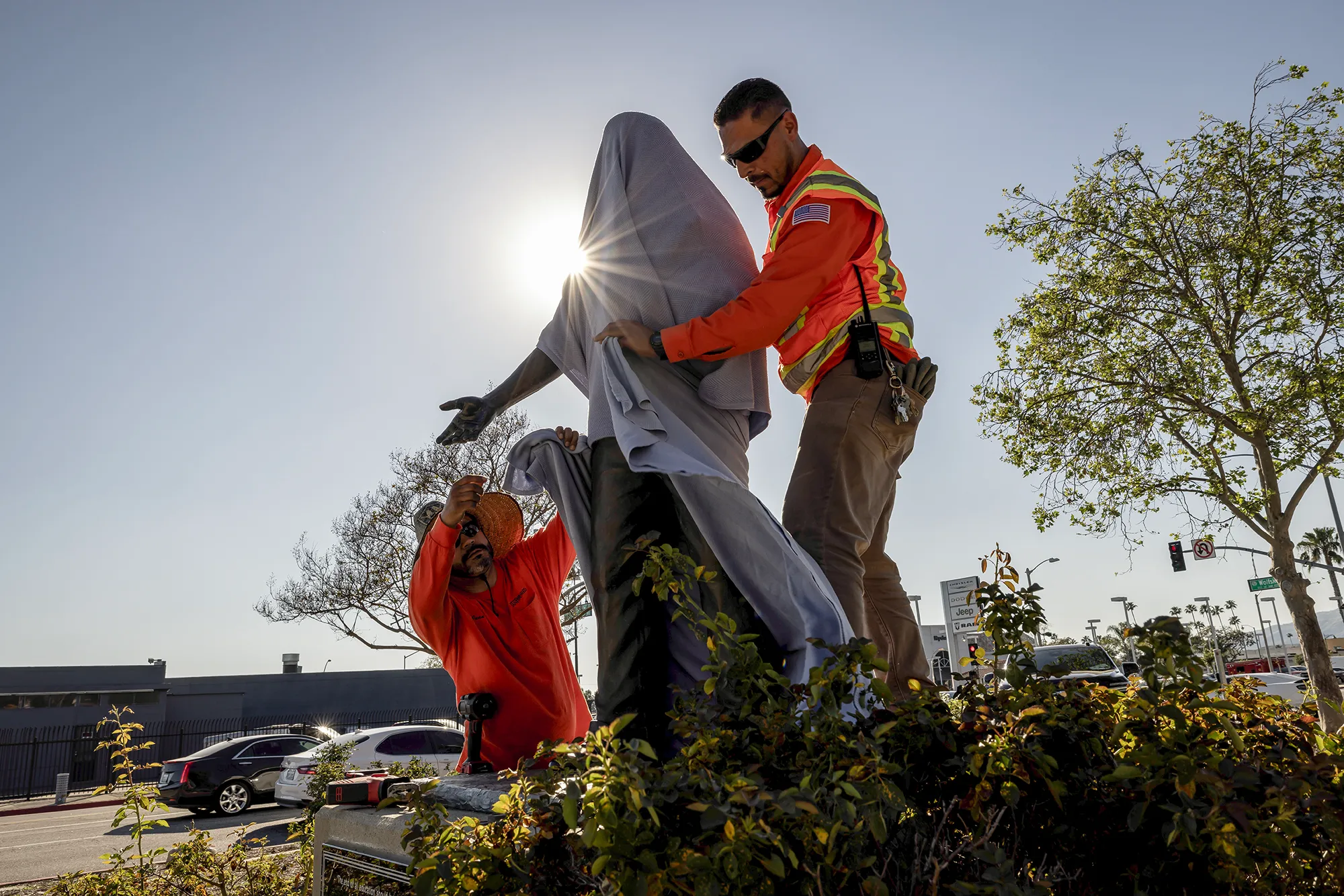
At both Fresno State and Cal State San Marcos, statues of Chávez were covered and removed within two days of The Times story publishing.
At San Joaquin Delta College, a ceramic relief and plaque memorializing Chávez was replaced with a mural honoring farmworkers painted by Delta College students. UC Berkeley removed Chávez’s name from a student center. UCLA’s department of Chicano Studies removed Chávez from its name.
While some suggested replacing Chávez’s name with Huerta’s, faculty are instead advocating for an approach that is more deliberate, and can commemorate the collective rather than one leader.
“If Dolores Huerta’s name comes up, I want it to go up based on her own achievements and merits, not based on reaction to allegations against César Chávez,” said Lorena Oropeza, professor of Chicanx Latinx Studies at UC Berkeley.
Campuses are also grappling with changes to curriculum involving Chávez. At Bakersfield College, some faculty advocated for the immediate elimination of the César Chávez Leadership Certificate, a program that teaches students about community organizing through the history of Chávez’s legacy in the farmworker movement in the southern San Joaquin Valley.
Rosales, who created the certificate program, said that any changes to curriculum should be deliberated and thought through, rather than just removed. While no faculty has yet made a motion to the Academic Senate for changes, he said he and department colleagues support any name change going through the senate process.
“If you actually look at the curriculum, it’s exactly the curriculum that we need, because it basically broadens the history beyond the UFW,” Rosales said.
A historical critique in ethnic studies
In history books, a key moment in Chávez’s legacy is the 1965 Delano Grape Strike, when workers went on a five-year-long strike demanding fair pay and better working conditions. What is often left untold is that Larry Itliong and Philip Vera Cruz, who were Filipino-American labor leaders, initiated the strike. The Agricultural Workers Organizing Committee, led by Itliong, and the National Farm Workers Association, led by Chávez, merged to form the United Farm Workers. Their organizing resulted in a national grape boycott and victory.
Disciplines like ethnic studies have long explored the complex and often contradictory nature of labor movement leaders. Scholars have examined Chávez’s anti-immigrant stance and studied the farmworkers’ movement through oral histories from workers and families.
At UC Berkeley, Oropeza researches antiwar and racial justice movements of the 1960s. In this decade, the farmworker movement was a part of the growing Chicano movement, which also encompassed college campus protests advocating for ethnic studies, land reclamation, and civil rights. Leaders like Chávez became major figures in the Chicano movement.
One of the leaders Oropeza has researched is Reies López Tijerina, a Chicano leader from Texas who led a major land grant movement in the American South in the 1960s to reclaim ancestral lands given away after the Mexican-American War. However, Oropeza’s research also revealed how he subjected his family to abuse.
As the leader of the Alianza Federal de Mercedes, or Federal Alliance of Land Grants, Tijerina led peaceful protests in Albuquerque and Santa Fe and occupied the Echo Amphitheater, renaming it the “Republic of San Joaquin del Rio Chama.” That act resulted in the arrests of La Alianza members.
Read more California pension ruling limits how many vacation hours workers can count for retirement
Most notably, Tijerina and La Alianza members led an armed raid of a courthouse in Tierra Amarilla, New Mexico, to perform a citizen’s arrest of the local district attorney, accusing him of denying the activists their civil rights. Tijerina was arrested following the raid, leading to national attention for the civil rights and Chicano movements.
Oropeza’s book, “The King of Adobe: Reies López Tijerina, Lost Prophet of the Chicano Movement,” was published in 2019. She traces Tijerina’s legacy in revitalizing the land grant movement, but also how he exerted patriarchal control in his leadership. Her research relies on archival records and oral histories, including interviews with Tijerina’s first wife and eldest daughter, who described patterns of physical and sexual abuse. Tijerina died at the age of 88 in 2015.
“How do you hold together this person who was absolutely brilliant when it came to criticizing U.S. expansion and what it meant for Spanish speakers on the ground in the new American Southwest, but was absolutely reprehensible in how he treated his family?” Oropeza said. In her book, she examines “both of those truths” and used gender to analyze the style of his leadership.
Oropeza has researched Chávez’s leadership in the farmworker movement extensively. She recalls “powerful images” of him, such as how he fasted to call attention to the struggle of farmworkers and how he turned culture into a political resource, like when he went on a pilgrimage from Delano to Sacramento during lent with the farmworkers. Many have referred to Chávez as “El Santo” or “the Saint of the Movement,” Oropeza said.
Now, to process the news of the allegations against Chávez, Oropeza is leaning on both her own research and ongoing critiques of Chávez in the field. Miriam Pawel’s biography of Chávez, “The Crusades of César Chávez,” published in 2014, narrates a critical history of the man, including his anti-immigrant stance, autocratic power over the union, and how he undermined other labor movements.
“I have already spent 12 years thinking about ‘How do you write about people who are complex, people who can act in reprehensible ways who can also do great things?’” Oropeza said.
Looking toward the future of studying the Chicano and farmworker movements, Oropeza believes that any study must reconcile various realities in an attempt to get as close as possible to the truth, no matter how complicated.
“To me, this is just a reminder that this endeavor we are engaged in as academics … it is imperfect,” Oropeza said. “They’re always going to approximate ‘What is the truth?’ Is there a singular truth? It gets closer and closer and closer, but never quite gets there.”
New and continued approaches in teaching
Alina Mendez, a professor of Chicano and Latin American studies at Fresno State, has experienced what it means for the personal and political to be connected as her parents were farmworkers. When she talked about the allegations against Chávez with her students during a lecture about the farmworker movement, she asked them whether they should continue talking about Chávez and, if so, how.
“As a scholar, obviously, I learned and teach this history,” Mendez said. “But as a daughter of farmworkers, I grew up honoring the memory, the legacy of César Chávez.”
Her classroom came to a consensus that they should continue learning about Chávez while holding him accountable, “with the hopes that this (abuse of power) doesn’t happen (again),” she recalled.
“I can very much see that there’s this collective grief, collective disappointment, a kind of questioning of ‘If César Chávez is no longer our hero, then who do we look up to?’” Mendez said. “That’s why I’ve been insisting that (we) look at our local communities. Let’s look around us and see other people who very much sacrificed a lot of time, a lot of resources, a lot of sweat, to make those successes possible.”
Mendez is changing her approach to teaching farmworker movements to focus on local leaders and histories. She has been in conversation with Arte Américas, a Fresno-based Latinx art and cultural center, to continue collecting archives and interviews with workers across the Central Valley.
“In many ways, obviously, my teaching is changing,” Mendez said. “As historians, I think we’re understanding more and more the importance of focusing on the collective rather than the individual leader.”
Faculty say the disciplines of ethnic studies and history will be essential to the future of teaching about farmworker history. They say scholars should focus now on collecting oral histories narrated by workers themselves, rather than letting dominant voices narrate their stories for the movement.
“If anyone can help us figure out how to deal with complexities around race in the United States, it’s ethnic studies,” Oropeza said. “This is a place where ethnic studies scholars will shine.”
Rosales said he hopes this moment can pave the way for research that highlights the contributions of more communities in the farm labor movement, including Arab Americans and Southeast Asian Americans.
“I think that the farmworker movement’s legacy is intact, but it’s going to take, you know, careful work by teachers, scholars, historians, to ensure that the curriculum is diversified beyond Chávez,” Rosales said.
Khadeejah Khan is a contributor with the College Journalism Network, a collaboration between CalMatters and student journalists from across California. CalMatters higher education coverage is supported by a grant from the College Futures Foundation.
Read more California bill would let abuse victims use trauma as legal defense for violent crime